
This blog post discusses the development of graph theory algorithms in Raku. Moderate number of examples is used.
Tag Archives: rakulang
Day 11 – Counting up concurrency
by Hillel Wayne Consider the 4-step process S = abcd and the 3-step process T = xyz. The processes run concurrently and can interleave at any point, but must execute in sequence. So abxcyzd is a valid interleaving, but baxcyzd is not. Also, steps in different processes can occur simultaneously: abxcyzd is different from a[bx]cyzd. How many valid interleavings are there? I ran into thisContinue reading “Day 11 – Counting up concurrency”
Day 10 – How to give a Raku talk at TPRC – and why you should

My goal for this post is to convince you – yes, you, current reader – that you both can and should present a talk about Raku for The Perl & Raku Conference this year. Statistically, I’m assuming that you’re not currently planning to give a Raku talk, so I’ve got my work cut out forContinue reading “Day 10 – How to give a Raku talk at TPRC – and why you should”
Day 9 – The end of the year
Yes, this year is almost finished, and Santa Claus needs to get his work done. Of course, helped by many volunteers. But sometimes it is a bit too much. Well, Santa Claus is a tough man, I know that for sure, he can handle stress! The other day, however, he came rushing in, terrified, paleContinue reading “Day 9 – The end of the year”
Day 8 – Yet More Abilities for Iterables
by Mustafa Aydın Raku has a superb support for Iterables — for example, map is almost like a basis for whatever operation you’d like to do with your iterable or there is the Iterator protocol that is kind of a NAND gate that you can use to build any circuitry over your iteration logic. But would it be even finer to have moreContinue reading “Day 8 – Yet More Abilities for Iterables”
Day 7 – Conditionally Writeable Attributes
by landyacht While designing an event system for a personal project, I ran across a requirement which I knew could be implemented elegantly with Raku’s metaprogramming capabilities. Specifically, I wanted both sync and async events, with the sync events allowing mutation of fields (e.g. for cancellation), and the async ones being merely informational and thusContinue reading “Day 7 – Conditionally Writeable Attributes”
Day 6 – Creating a presentation hosted on a Gemini capsule
The fiddly process of making presentations Many of us have been in a situation where we need to whip up a quick presentation. We might enjoy doing a talk on the subject material, but the thought of having to make presentation slides can take some joy out of it. One of my requirements was toContinue reading “Day 6 – Creating a presentation hosted on a Gemini capsule”
Day 5 – Generating an HTML Dashboard With Vanilla Raku
by Coleman McFarland The goal of this post is to demonstrate some Raku features by accomplishing something useful in about 100 lines of Raku. We’re going to avoid using libraries, and instead use only what’s available to us in the core language. Our task requires wrapping the GitHub CLI and generating an HTML dashboard. We’llContinue reading “Day 5 – Generating an HTML Dashboard With Vanilla Raku”
Day 4 – Don’t use Forsyth-Edwards Notation to play chess with LLMs
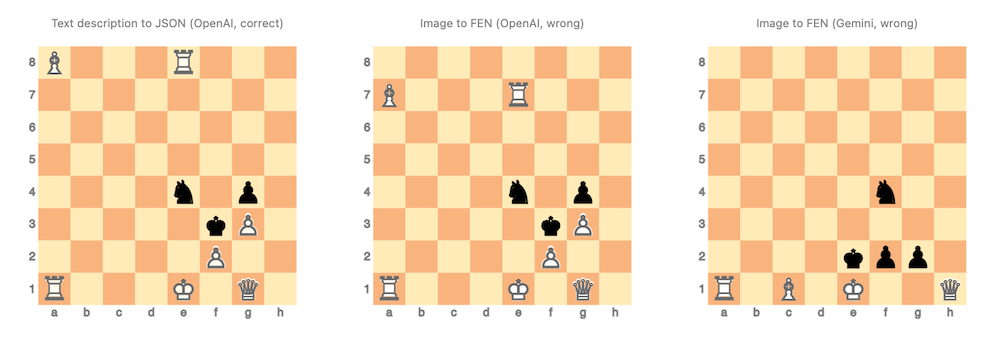
The article discusses the limitations of using Forsyth-Edwards Notation (FEN) for chess interactions with Large Language Models (LLMs). The document introduces various topics, including creating visual plots of chess positions, and developing an LLM persona called “ChessMaster” for interactive chess play.
Day 3 – Merry Cromas
The elves were keen to have an attractive Christmas tree this year. As usual, they wanted to build it with raku, their favourite programming language. They dug back into the archives of Christmas past and came up with a pretty good way to make a tree – Santa and the Magic Tree. But honestly theyContinue reading “Day 3 – Merry Cromas”
 Raku Advent Calendar